
Animalia City Guide
This article is an entry in the citizen-edited encyclopedia Animalopedia. Years and districts follow Animalia-Map and TMA-History-Animalia; matters of daily life follow TMA-Daily-Life. For detailed guidance on individual venues, see the sister article TMA-Landmarks (a gazetteer of sites and spots).
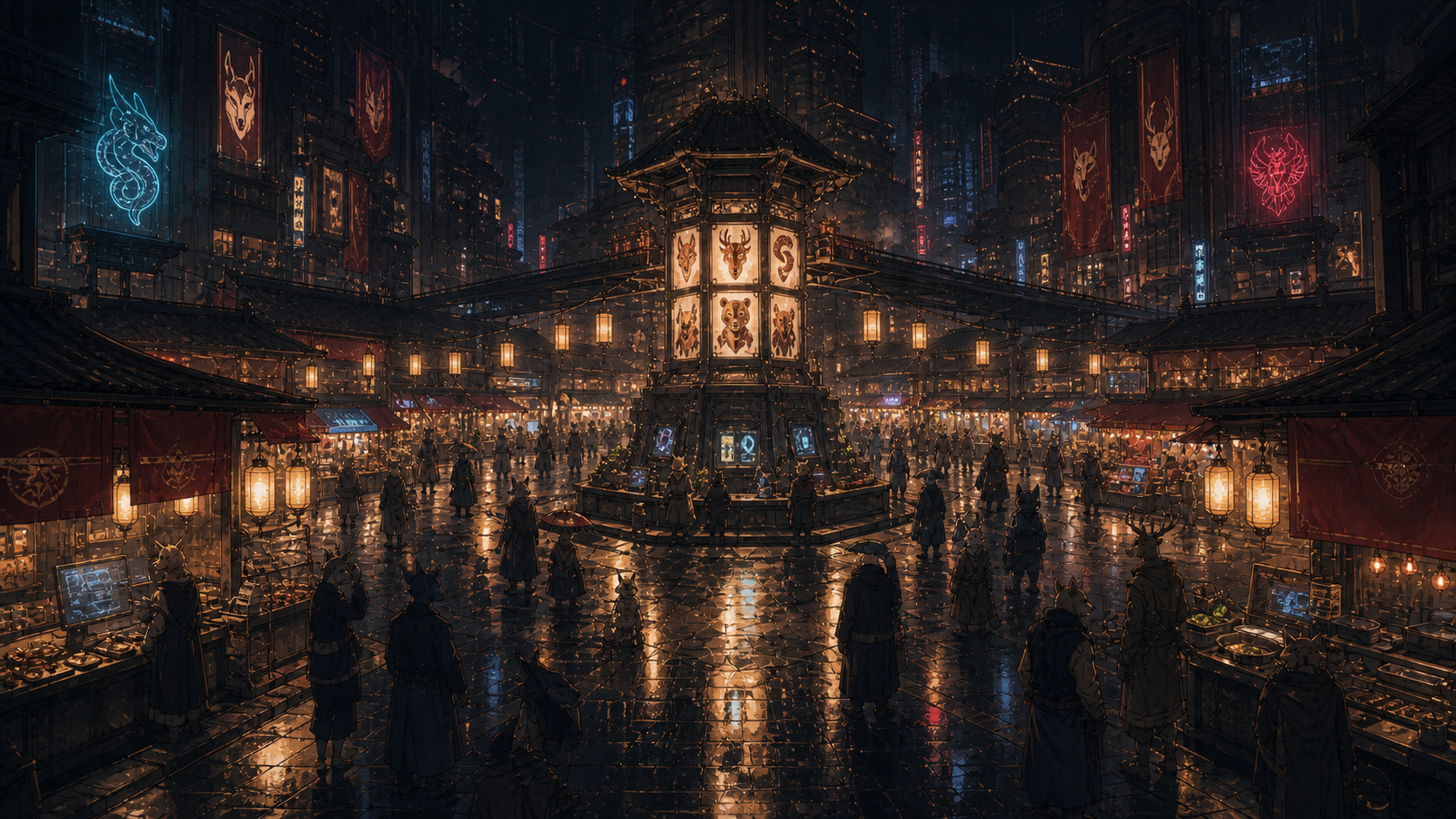
The Animalia City Guide is a practical handbook for those visiting the city for the first time — or for anyone who, coming off a night shift, boarded the wrong transfer. Animalia has no closing time; only the species minding the shop changes. If the city must be summed up in a single line, that is it. It is a "three-shift city," where three time-bands — diurnal, nocturnal, and crepuscular — rotate through the same blocks; the old-timers' advice is to confirm which time-band you are in before you check the clock 〔citation needed〕.
1. First Things to Learn — How to Get Around
- The city changes its face by the hour. The same street is a market by day, a negotiating floor by evening, a festival by night. Confirm your destination's "operating species-band" before you set out.
- The Metro is the spine. Four trunk lines and the Biome Ward line meet in the Central District. Cars run at different temperatures (see below), so read each car's temperature display before boarding. The sight of a polar-climate creature stranded in a tropical car is an everyday spectacle.
- The "office" is faster than the police box. For disputes, lost property, or directions, the downtown wisdom is that the office of the Family that keeps that street is the surest bet (→ TMA-Police). But "borrow the flame, don't look into the fire" — the rule for getting by is not to pry into what goes on inside.
- The rain is more punctual than the clock. The squalls in the Jungle Ward fall on schedule. It never hurts to carry an umbrella.
2. Districts at a Glance
The origins and history of each district are covered in detail in TMA-History-Animalia. Here we list only "what you go there to do."
| District | In a word | What you go for |
|---|---|---|
| The Central District (around Oracle Tower) | The city's quietest downtown | Government paperwork, panoramas, luxury housing. "Under the tower, carry an umbrella." |
| The Old South Quarter (Vecchio) | The singing old town | Opera, long dinners, mourning. Cobblestones and bell towers |
| The Moonview Quarter (Tsukimi-chō) | A town of incense and sprinkled water | Fairs, teahouses, ship's chandlery. On full-moon nights, custom comes from beyond the city |
| Chinatown (inside the Tenryū Gate) | The kitchen that never sleeps | Street stalls, medicinal herbs, Daoist reagents. The specialty is the Hundred-House Hotpot |
| Frost Harbor (the northern port) | A taciturn harbor of ice | Cold-storage warehouses, shipping, black-market rumors. In winter, its voice carries more weight |
| The Gilt Mile (the casino and finance district) | The clockless quarter | Gambling halls, show business, finance. You set meetings by "so many rounds from now" |
| The Biome Wards (Jungle / Savanna / Polar / Desert) | Four climates on one continuous ground | Cross-biome commuting, the Night Safari, the Olympics. See TMA-Nature |
| Willowside (the western residential district) | Where the city looks most ordinary | Housing, and the gateway to the Forest Park and Reflection Lake. Terminus of Line 3 — "no news is the news," they say |
| Broken Burrow (the beastfolk quarter) | Poor, and fiercely loyal | Day-labor markets, soup kitchens. "Never refuse a light." |
| Fog Port (the misty harbor) | The harbor where nothing is asked | Water freight, full-moon escort contracts. Praise the ship's name; never mention its draft |
| The Glitch Zone (the east) | The east you'd do better to avoid | ——No one has business here. "What you pick up in the east, return to the east." |
3. Citizens' Picks ① Shops
Editor's note: Listings are submitted by citizens. Prices are approximate as of AE 120 (→ TMA-Economy-AMT). No closing time is given because there isn't one.
| Place | Location | Specialty / Use | What the citizens say |
|---|---|---|---|
| The Dawn Congee Stall | Neon Crossroads (morning market) | Greens congee (herbivore), broth congee (carnivore), a skewer of insects on the side | "Predator and prey slurp from the same bench. I've never seen anyone start a fight here." |
| Nocturne Mart | Citywide (24-hour chain) | An all-purpose convenience store whose shelves turn over with the clientele every eight hours | "The head temple of the late-night standing chat. Stock up on rumors at the register." |
| The Hundred-House Hotpot stalls | Chinatown, beside the Seisō Market | A great cauldron to which dozens of stalls each contribute their ingredients. By the bowl | "First time, don't count the dragon's whiskers. Just eat, quietly — it's good." |
| Predators' Paradise | The Gilt Mile | An upscale club for carnivores; for other diets, an odorless "courtesy plate" | "You can tell first class by the smell of the plate. Never compliment another's staple food." |
| The Kyōgetsurō (Mirror-Moon Pavilion) | The Moonview Quarter (Tsukimi-chō) | A teahouse where information has a going rate; rumor runs pricier than tea | "Settle the bill in tea money; leave your tip in silence." |
| Midnight Café Noir | The neutral zone | A late-night café with poor reception. A perch for fugitives and information brokers | "When your phone loses signal, you've found the right seat." |
| Jumbo Liquors (wholesale) | Behind every liquor shelf citywide | It wholesales the liquor for every convenience store in the city 〔known to those who know〕 | "Every can carries Jumbo's fingerprints, the old man says." |
4. Citizens' Picks ② Spots
| Spot | Location | How to enjoy it | A word |
|---|---|---|---|
| Aurora Park | The north | Holographic artificial aurorae. A family staple | By day, a place to rest; by night, a place for secret meetings. The same bench serves two purposes 〔citation needed〕 |
| The Veil Waterway | The canal network of the Central District | Stone bridges and neon on the water. One of the finest date spots | Also an upscale residential quarter for aquatic species. Boating is best under a full moon |
| Crystal Skywalk | The Central District (300 m above ground) | A transparent aerial walkway linking the skyscrapers. Night views | Locals say "the air up there is oddly easy to breathe" 〔by whom?〕 |
| Reflection Lake | The forest park | A silent lake with no reception. Picnics | Said in legend to "reflect the future." That it is also popular with those holding secret talks is best kept quiet |
| The Memorial Wall | The neutral zone | A wall that mourns the dead of the Decade of Blood without regard to Family | The one place in the city where no one draws a weapon. The flowers are never gone, whenever you come |
| Echoes Library | The oldest library, dating from the Founding era | Forbidden books and ancient texts. Reading and napping | Protected under Article Five of the Accord. Rather than borrowing, the etiquette is to "read and run" |
| Tree Market | Rooftops of high-rises and aerial walkways | The market where arboreal species' dealmaking is at its liveliest | When you can walk past the "licensing agent" signs without stopping, you've come of age |
5. Metro Timetable
Published by the Animalia Transit Authority (revised AE 120). The Metro's Lines 1–4 plus the Biome Ward line meet in the Central District. It opened in AE 7, during the construction era. Being a three-shift city, the notion of a "last train" is faint; each line thins its service in the twilight bands but runs nearly around the clock.
5-1. Line List
| Line | Route | Operating hours | Rolling-stock notes |
|---|---|---|---|
| Line 1 (Loop Line) | Circles the Central District: Oracle Front — the Gilt Mile — Vecchio — Chinatown — the Central District | 04:50–02:30 next day (suspended in the witching hour) | Standard temperature. At peak times, cars reserved by species |
| Line 2 (North–South Line) | Frost Harbor ⇄ the Polar Ward ⇄ the Central District ⇄ Vecchio in the south | Nearly all day | Northbound, the cabin temperature drops in stages |
| Line 3 (East–West Line) | The eastern zone edge ⇄ the Central District ⇄ the western residential district | 05:20–01:40 next day | The two easternmost stations turn back at the "zone edge" (→ TMA-Landmarks) |
| Biome Ward Line (Line 4) | The Jungle Ward ⇄ Savanna Square ⇄ the Polar Ward | Nearly all day | Temperature set per car. Check the car display before boarding |
| Line 13 (──) | Not shown on the route map | Midnight 00:00–03:00 only 〔citation needed〕 | Some claim they have "ridden it," but no one has ever produced a ticket |
5-2. Service Intervals (by time band)
To match the rhythm of the three-shift city, the intervals vary greatly by time band. The ticket gates are busiest in the twilight bands when the species change over — this is called "the Ebb."
| Time band | Nickname | Interval | Notes |
|---|---|---|---|
| 07:00–09:00 / around 12:00 | Daytime peak (diurnal) | About 3 min | The commute-and-lunch surge |
| Around sunrise and sunset | the Ebb (twilight, reduced service) | About 8–10 min | The night shift heading home passes the morning commute at the gates |
| 20:00–24:00 | Nighttime peak (nocturnal) | About 4 min | Toward the stall districts and the lower floors of the casinos |
| 02:00–04:00 | The witching hour | About 12 min | Lines 1 and 3 are suspended. The hour when the platforms fall most silent |
Metro tips: (1) Board the wrong-temperature car and you'll lose a one-way trip's worth of stamina. (2) The waterways (the Veil Waterway / the boats of the Aqua-Fin Alliance) are strong on rainy days. (3) Trams and buses are the capillaries of the Metro's blank spots. (4) If, past midnight, you spot an unfamiliar Line 13 sign on the platform, whether you board is at your own risk.