
The Biome Wards & the Weather
This is an article of the Animalopedia, the citizens' encyclopedia of Animalia. Dates follow TMA-Timeline; district origins follow TMA-History-Animalia; directions and metro lines follow TMA-City-Guide.
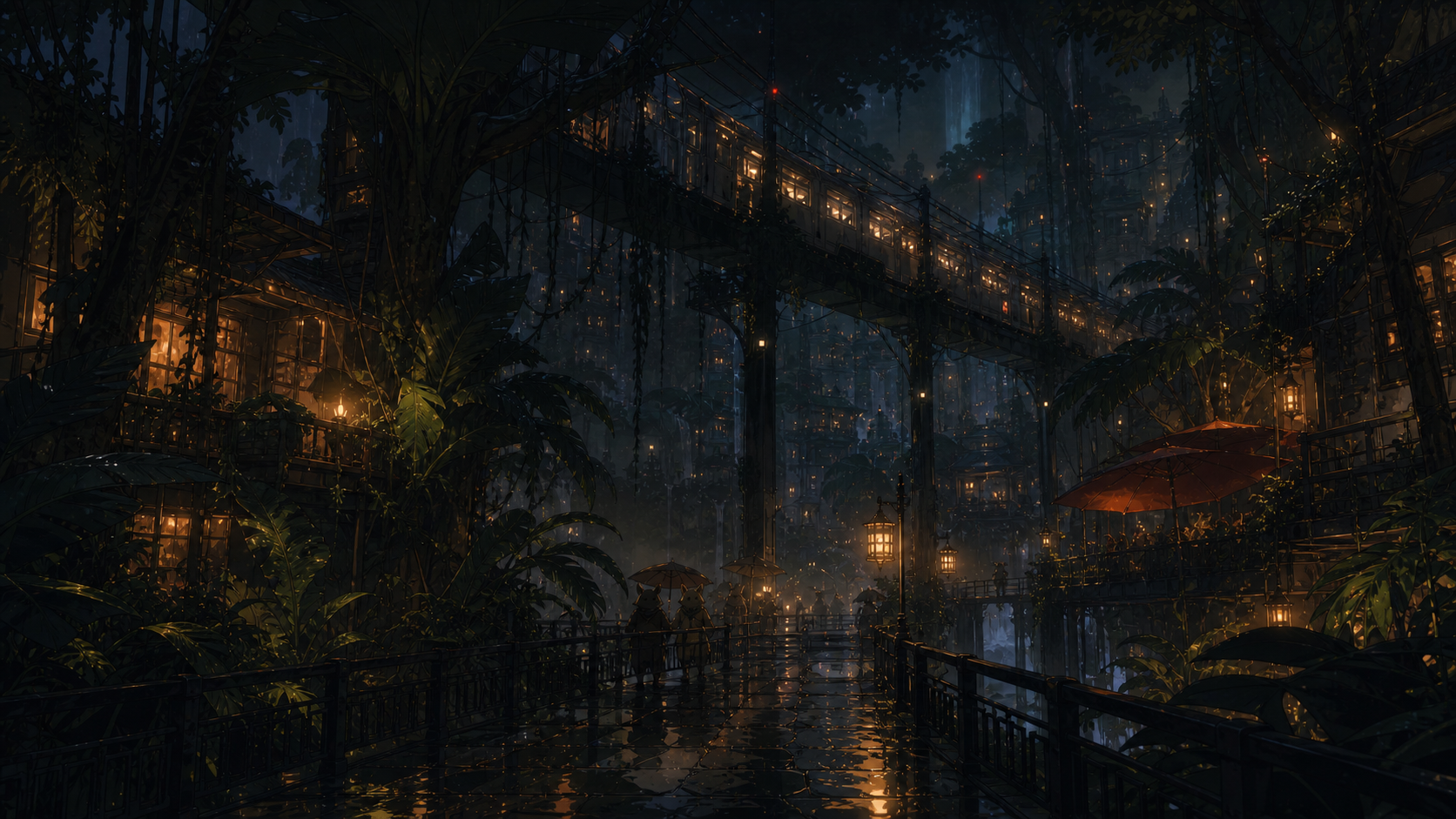
The Biome Wards & the Weather covers the artificial climate system of the city-state of Animalia and its four engineered biome wards — the Jungle Ward, Savanna Square, the Polar Ward, and the Desert Ward. In Animalia, weather is not something that arrives; it is something that is delivered. The Tuning Forecast published by the Climate Tuning Division of Oracle Tower has almost never been wrong since the Founding, and citizens think not about whether to carry an umbrella, but about what time to open it 〔citation needed〕.
1. Weather Tuning — a city where the weather keeps a timetable
- The Climate Tuning Division is a department of the Oracle Tower administration, managing temperature, rainfall and wind city-wide since the Founding (AE 1) (→ TMA-Politics).
- The Tuning Forecast: called a "forecast," it is in truth a schedule. The weather column of the TMA Times reads, to the minute: "Tomorrow's rainfall: 14:00–14:40 (Jungle District)." Small talk about the weather does not work in this city; its place is taken by the post-game review — "today's squall ran long, didn't it."
- The smell of ozone after rain: tuned rain leaves a faint ozone scent. Some whisper it is "proof that even the weather is managed"; most citizens pay it no mind (→ TMA-Daily-Life).
- Thunder is rarely delivered. A few nights a year, distant thunder rolls on what old-timers call "equipment inspection nights" 〔citation needed〕.
- The exception — the fog of Fog Port: the only weather in the city said to escape tuning. To every inquiry the Division has answered, without explanation: "outside our jurisdiction." The port is rather proud of this — "better to keep one weather the tuners can't touch, or there'd be nothing left to talk about" 〔citation needed〕.
2. The Four Biome Wards — a district guide
The biome wards are artificial climate zones built by the Climate Tuning Division, completed in time for the first Interspecies Olympics in AE 73 (→ TMA-Timeline). Construction was staged: the Polar Ward came first and the Desert Ward last (Animalia Society for Civil Engineering History, Fifty Years of Groundworks, AE 118). The four wards are linked by the Biome Ward Line (Metro Line 4), whose cars are set to different temperatures (→ TMA-City-Guide).
2.1 The Jungle Ward — where the rain is more punctual than the clocks
A hot, humid ward for tropical species. Its signature is the scheduled squall — falling at a fixed hour, lifting at a fixed hour, every day. The saying "an umbrella is more accurate than a clock" was born here, and the annual revision of squall times is a matter of grave local concern (an extra edition is printed on announcement day).
- The Canopy Walk: the arboreal species' street network. Commerce splits into two layers, and one address may hold an "upper shop" and a "lower shop."
- The spice concentration of its food stalls is the highest in the city (→ TMA-History-Animalia). The steaming stall street just after a squall is a famous venue for deals struck under the pretext of sheltering from rain.
- Local saying: "He who is late for the squall is late for the deal."
2.2 Savanna Square — the sunlit commons
The center of assembly and trade for the great mammals. The open grassland stands for "having nothing to hide," and in this ward an open-air pitch outranks a roofed shop — a famous inversion. "Sunlit talk belongs in the sunlight" is known well beyond the ward (→ TMA-History-Animalia).
- Two seasons: the Division switches the ward between dry and rainy season twice a year. The first day of the rains — "the Beginning Rain" — is a local holiday, and to be caught in it is good luck.
- The noon nap: for about thirty minutes at midday, all business in the Square stops. "A nap in the sun is an asset," goes the local phrase; calling on someone during it is a discourtesy.
- The opening ceremony of the Interspecies Olympics is traditionally held here (→ TMA-Sports).
2.3 The Polar Ward — the white quiet
A low-temperature ward for cold-climate species, said to be the earliest of the wards, and the principal stronghold of the Tundra Syndicate. It connects directly to Frost Harbor by the ice haul road (→ TMA-History-Animalia).
- The ward's political specialty is the seasonal transfer of power, by which the district's voice grows louder in winter (→ TMA-Politics).
- One theory holds that the artificial aurora of Aurora Park was first trialed here 〔citation needed〕.
- On the night of the Winter Send-off in the twelfth month (→ TMA-Religion), ice statues are set out in the ward's commons; a statue that survives to spring is said to prove its maker "sleeps well."
2.4 The Desert Ward — where the heat terminates
A hot, arid ward for dry-climate and reptilian citizens. It is famous for its design: the waste heat drawn off to cool the Polar Ward is piped here. The Division's motto — "the cold of the pole is the warmth of the desert" — is quoted as the emblem of the biome wards themselves.
- By day it is nearly empty; the market rises after sundown. This Evening Market (Yoiichi) is beloved of the crepuscular and the nocturnal.
- Nights are the coldest in the city — and the least light-polluted. Stargazers' Hill is Animalia's only true astronomy spot; the tide-readers of the lunar faith gather here on new-moon nights (→ TMA-Religion).
- Access: the Desert Spur (extended AE 96) from Savanna Square station on the Biome Ward Line.
- Local saying: "The sand keeps no footprints" — the Evening Market does not ask where you came from.
2.5 The Seam — where the wards meet
Citizens call the few dozen meters where one climate gives way to another "the Seam." Stand on it and half of you is in summer, half in winter — a famous spot for photographs. A shop on the Seam needs double doors and a double menu; that the "Seam Café" serves shaved ice and hot saké on the same tray is at once its attraction and a simple necessity 〔citation needed〕.
3. Parks, water, and green
| Place | Notes |
|---|---|
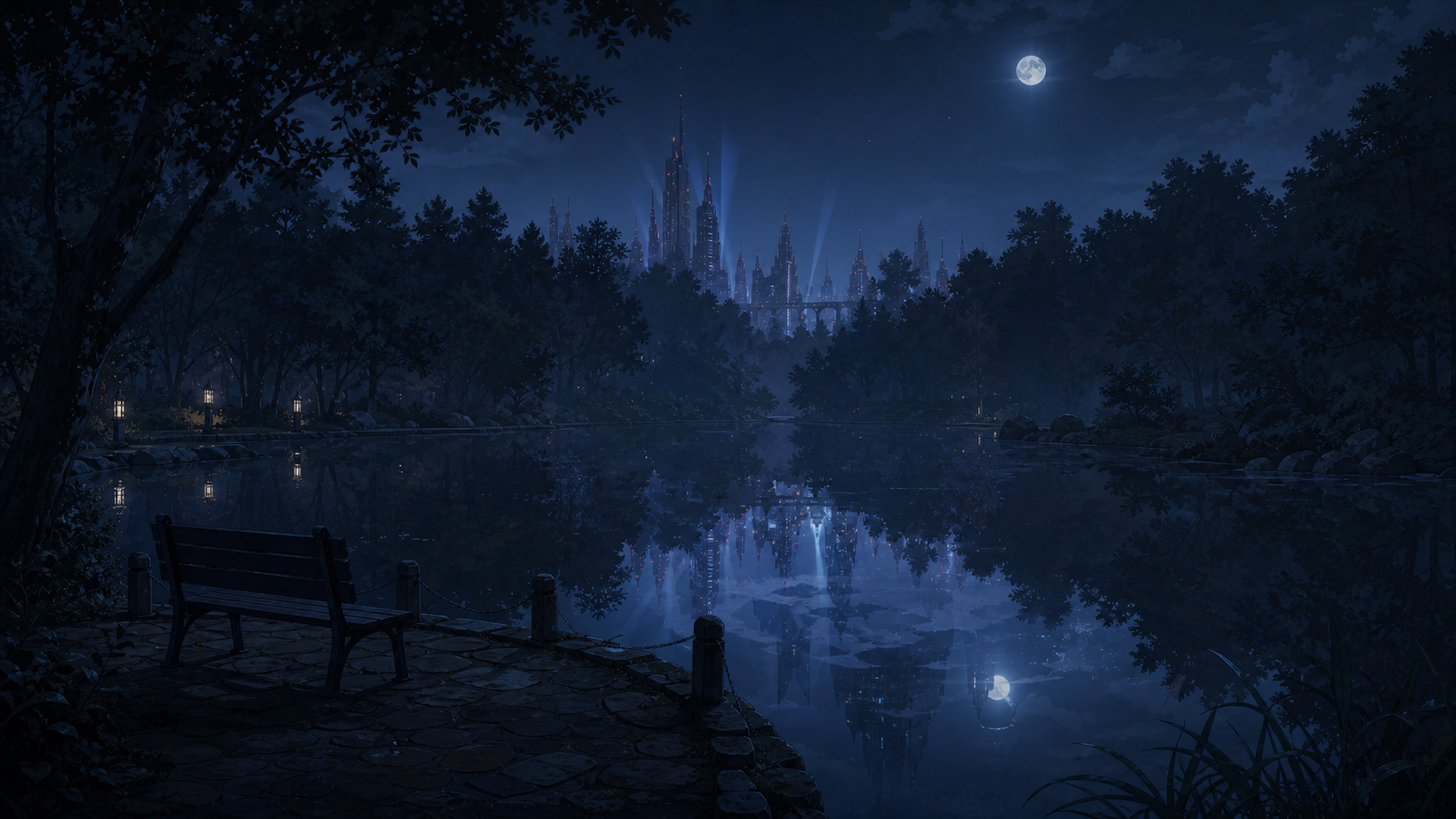
| The Forest Park | The city's largest greenbelt, at the gateway of Willowside, the western residential ward. Deep inside lies Reflection Lake, the silent lake where no signal reaches (→ TMA-Landmarks) |
| Aurora Park | The northern park of artificial aurora. The holographic lights are refreshed nightly; no sky is ever shown twice, they say 〔citation needed〕 |
| The Millennium Tree | The great tree behind Hualong Castle in Chinatown; seat of the Great Tree faith (→ TMA-Religion). The Division openly states that it "tunes gently" around the tree, explaining only: "out of respect" |
| Veil Waterway | The central canal network, doubling as the aquatic species' finest addresses (→ TMA-City-Guide) |
| Rooftop greenery & sky-corridors | The arboreal life-sphere centered on the Tree Market. The city's green-coverage statistics come in two tiers: "ground" and "canopy" (→ TMA-Landmarks) |
4. Seasons and hibernation
- Outside the biome wards, the central city and the old quarters are tuned to "temperate four seasons." The cherry blossoms of the third month (the grave-visiting at Zennin-ji → TMA-Religion), the dry festival weather of the tenth, the first snow of the twelfth — all arrive on time.
- Hibernation: hibernating citizens hand their offices to deputies at the Winter Send-off in the twelfth month; this seasonal transfer of power is a council-recognized institution (→ TMA-Politics). The pre-hibernation "last-feast" is a winter fixture of the old quarters; an invitation is not to be declined.
- Migration: whether "migration leave" for migratory-bird citizens should be paid is a perennial dispute of the Ecosystem Council 〔citation needed〕.
5. Frayed weather — the recent anomalies
Since the AE 110s, testimonies of "fraying" weather have multiplied along the edge of the Glitch Zone: snow that falls upward, square raindrops, and squalls that do not come on time. The city's explanation has not varied: "instrument malfunction."
- In the sixth month of AE 119, the scheduled squall of the Jungle Ward ran four minutes late. The Division does not acknowledge that any record of this exists; every resident of the district remembers it 〔citation needed〕. The stall street calls that day "the day the clocks got wet."
- In the Gilt Mile there are old men who bet, year after year, on "the day the Tuning Forecast is next wrong." Rumor holds that the squall delay of AE 119 produced the first payout in history (→ TMA-Sports).
The municipal broadcaster repeats that these are "baseless rumors"; at the late-night registers of Nocturne Mart, they are the only topic. The neutrality of this section is disputed.